


TA-003-P Exam Dumps - PDF Questions and Testing Engine
TA-003-P Dumps - The Sure Way To Pass Exam
NEW QUESTION # 41
How is terraform import run?
- A. As a part of terraform init
- B. As a part of terraform refresh
- C. All of the above
- D. As a part of terraform plan
- E. By an explicit call
Answer: E
Explanation:
The terraform import command is not part of any other Terraform workflow. It must be explicitly invoked by the user with the appropriate arguments, such as the resource address and the ID of the existing infrastructure to import. Reference = [Importing Infrastructure]
NEW QUESTION # 42
What are some benefits of using Sentinel with Terraform Cloud/Terra form Cloud? Choose three correct answers.
- A. You can check out and check in cloud access keys
- B. Policy-as-code can enforce security best practices
- C. You can enforce a list of approved AWS AMIs
- D. Sentinel Policies can be written in HashiCorp Configuration Language (HCL)
- E. You can restrict specific resource configurations, such as disallowing the use of CIDR=0.0.0.0/0.
Answer: B,C,E
Explanation:
These are some of the benefits of using Sentinel with Terraform Cloud/Terraform Enterprise, as they allow you to implement logic-based policies that can access and evaluate the Terraform plan, state, and configuration. The other options are not true, as Sentinel does not manage cloud access keys, and Sentinel policies are written in Sentinel language, not HCL.
NEW QUESTION # 43
When does Sentinel enforce policy logic during a Terraform Cloud run?
- A. During the plan phase
- B. Before the plan phase
- C. Before the apply phase
- D. After the apply phase
Answer: C
Explanation:
Sentinel policies are checked after the plan stage of a Terraform run, but before it can be confirmed or the terraform apply is executed3. This allows you to enforce rules on your infrastructure before it is created or modified.
NEW QUESTION # 44
HashiCorp Configuration Language (HCL) supports user-denned functions.
- A. True
- B. False
Answer: B
Explanation:
HashiCorp Configuration Language (HCL) does not support user-defined functions. You can only use the built-in functions that are provided by the language. The built-in functions allow you to perform various operations and transformations on values within expressions. The general syntax for function calls is a function name followed by comma-separated arguments in parentheses, such as max(5, 12, 9). You can find the documentation for all of the available built-in functions in the Terraform Registry or the Packer Documentation, depending on which tool you are using. Reference = : Functions - Configuration Language | Terraform : Functions - Configuration Language | Packer
NEW QUESTION # 45
What information does the public Terraform Module Registry automatically expose about published modules?
- A. Optional inputs variables and default values
- B. Outputs
- C. All of the above
- D. Required input variables
- E. None of the above
Answer: C
Explanation:
The public Terraform Module Registry automatically exposes all the information about published modules, including required input variables, optional input variables and default values, and outputs. This helps users to understand how to use and configure the modules.
NEW QUESTION # 46
Which are forbidden actions when the terraform state file is locked? Choose three correct answers.
- A. Terraform for
- B. Terraform destroy
- C. Terraform validate
- D. Terraform validate
- E. Terraform apply
- F. Terraform state list
Answer: B,C,E
Explanation:
The terraform state file is locked when a Terraform operation that could write state is in progress. This prevents concurrent state operations that could corrupt the state. The forbidden actions when the state file is locked are those that could write state, such as terraform apply, terraform destroy, terraform refresh, terraform taint, terraform untaint, terraform import, and terraform state *. The terraform validate command is also forbidden, because it requires an initialized working directory with the state file. The allowed actions when the state file is locked are those that only read state, such as terraform plan, terraform show, terraform output, and terraform console. Reference = [State Locking] and [Command:
validate]
NEW QUESTION # 47
Which of the following statements about Terraform modules is not true?
- A. You can call the same module multiple times
- B. Modules can call other modules
- C. A module is a container for one or more resources
- D. Modules must be publicly accessible
Answer: D
Explanation:
This is not true, as modules can be either public or private, depending on your needs and preferences.
You can use the Terraform Registry to publish and consume public modules, or use Terraform Cloud or Terraform Enterprise to host and manage private modules.
NEW QUESTION # 48
How could you reference an attribute from the vsphere_datacenter data source for use with the datacenter_id argument within the vsphere_folder resource in the following configuration?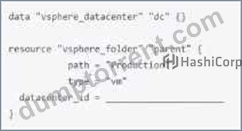
- A. Data,dc,id
- B. Data.vsphere_datacenter,dc
- C. Data.vsphere_datacenter.DC.id
- D. Vsphere_datacenter.dc.id
Answer: C
Explanation:
The correct way to reference an attribute from the vsphere_datacenter data source for use with the datacenter_id argument within the vsphere_folder resource in the following configuration is data.vsphere_datacenter.dc.id. This follows the syntax for accessing data source attributes, which is data.TYPE.NAME.ATTRIBUTE. In this case, the data source type is vsphere_datacenter, the data source name is dc, and the attribute we want to access is id. The other options are incorrect because they either use the wrong syntax, the wrong punctuation, or the wrong case. Reference = [Data Source:
vsphere_datacenter], [Data Source: vsphere_folder], [Expressions: Data Source Reference]
NEW QUESTION # 49
Outside of the required_providers block, Terraform configurations always refer to providers by their local names.
- A. True
- B. False
Answer: B
Explanation:
Outside of the required_providers block, Terraform configurations can refer to providers by either their local names or their source addresses. The local name is a short name that can be used throughout the configuration, while the source address is a global identifier for the provider in the format registry.terraform.io/namespace/type.
For example, you can use either aws or registry.terraform.io/hashicorp/aws to refer to the AWS provider.
NEW QUESTION # 50
terraform validate confirms that your infrastructure matches the Terraform state file.
- A. True
- B. False
Answer: B
Explanation:
terraform validate does not confirm that your infrastructure matches the Terraform state file. It only checks whether the configuration files in a directory are syntactically valid and internally consistent3. To confirm that your infrastructure matches the Terraform state file, you need to use terraform plan or terraform apply with the -refresh-only option.
NEW QUESTION # 51
When should you run terraform init?
- A. After you start coding a new terraform project and before you run terraform plan for the first time.
- B. Every time you run terraform apply
- C. Before you start coding a new Terraform project
- D. After you run terraform plan for the time in a new terraform project and before you run terraform apply
Answer: A
Explanation:
You should run terraform init after you start coding a new Terraform project and before you run terraform plan for the first time. This command will initialize the working directory by downloading the required providers and modules, creating the initial state file, and performing other necessary tasks. Reference = :
Initialize a Terraform Project
NEW QUESTION # 52
What is the Terraform style convention for indenting a nesting level compared to the one above it?
- A. With four spaces
- B. With a tab
- C. With three spaces
- D. With two spaces
Answer: D
Explanation:
This is the Terraform style convention for indenting a nesting level compared to the one above it. The other options are not consistent with the Terraform style guide.
NEW QUESTION # 53
Which of the following is not a key principle of infrastructure as code?
- A. Self-describing infrastructure
- B. Versioned infrastructure
- C. Idempotence
- D. Golden images
Answer: D
Explanation:
The key principle of infrastructure as code that is not listed among the options is golden images. Golden images are pre-configured, ready-to-use virtual machine images that contain a specific set of software and configuration. They are often used to create multiple identical instances of the same environment, such as for testing or production. However, golden images are not a principle of infrastructure as code, but rather a technique that can be used with or without infrastructure as code.
The other options are all key principles of infrastructure as code, as explained below:
Self-describing infrastructure: This means that the infrastructure is defined in code that describes its desired state, rather than in scripts that describe the steps to create it. This makes the infrastructure easier to understand, maintain, and reproduce.
Idempotence: This means that applying the same infrastructure code multiple times will always result in the same state, regardless of the initial state. This makes the infrastructure consistent and predictable, and avoids errors or conflicts caused by repeated actions.
Versioned infrastructure: This means that the infrastructure code is stored in a version control system, such as Git, that tracks the changes and history of the code. This makes the infrastructure code reusable, auditable, and collaborative, and enables practices such as branching, merging, and rollback.
Reference = [Introduction to Infrastructure as Code with Terraform], [Infrastructure as Code in a Private or Public Cloud]
NEW QUESTION # 54
As a developer, you want to ensure your plugins are up to date with the latest versions.
Which Terraform command should you use?
- A. terraform providers -upgrade
- B. terraform apply -upgrade
- C. terraform refresh -upgrade
- D. terraform init -upgrade
Answer: D
Explanation:
This command will upgrade the plugins to the latest acceptable version within the version constraints specified in the configuration. The other commands do not have an -upgrade option.
NEW QUESTION # 55
When using a remote backend or terraform Cloud integration, where does Terraform save resource sate?
- A. In an environment variable
- B. On the disk
- C. In memory
- D. In the remote backend or Terraform Cloud
Answer: D
Explanation:
This is where Terraform saves resource state when using a remote backend or Terraform Cloud integration, as it allows you to store and manage your state file in a remote location, such as a cloud storage service or Terraform Cloud's servers. This enables collaboration, security, and scalability for your Terraform infrastructure.
NEW QUESTION # 56
You should run terraform fnt to rewrite all Terraform configurations within the current working directory to conform to Terraform-style conventions.
- A. True
- B. False
Answer: A
Explanation:
You should run terraform fmt to rewrite all Terraform configurations within the current working directory to conform to Terraform-style conventions. This command applies a subset of the Terraform language style conventions, along with other minor adjustments for readability. It is recommended to use this command to ensure consistency of style across different Terraform codebases. The command is optional, opinionated, and has no customization options, but it can help you and your team understand the code more quickly and easily. Reference = : Command: fmt : Using Terraform fmt Command to Format Your Terraform Code
NEW QUESTION # 57
Which command lets you experiment with terraform expressions?
- A. Terraform test
- B. Terraform env
- C. Terraform console
- D. Terraform validate
Answer: C
Explanation:
This is the command that lets you experiment with Terraform expressions, by providing an interactive console that allows you to evaluate expressions and see their results. You can use this command to test your expressions before using them in your configuration files.
NEW QUESTION # 58
In Terraform HCL, an object type of object ({name=string, age-number}) would match this value.
- A.

- B.

- C.

- D.

Answer: C
NEW QUESTION # 59
......
Pass HashiCorp TA-003-P Exam Quickly With DumpTorrent: https://prepaway.dumptorrent.com/TA-003-P-braindumps-torrent.html