


[Sep-2025] SAP C-THR81-2505 Official Cert Guide PDF
Exam C-THR81-2505: SAP Certified Associate - SAP SuccessFactors Employee Central Core - DumpTorrent
SAP C-THR81-2505 Exam Syllabus Topics:
| Topic | Details |
|---|---|
| Topic 1 |
|
| Topic 2 |
|
| Topic 3 |
|
| Topic 4 |
|
NEW QUESTION # 18
When the manager updates the location of an employee, the HR admin must be the approver Note that the HR admin, manager, and HR Business Partner have access to change the location.
How do you create the IF condition for the workflow derivation rule lo meet the above requirements?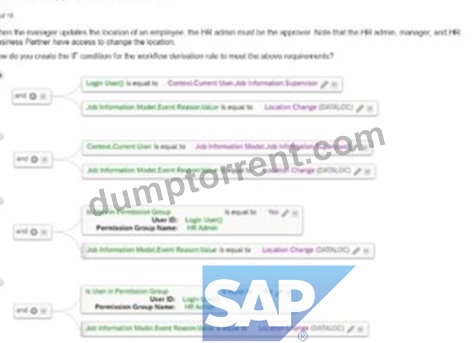
- A. Option A
- B. Option C
- C. Option B
- D. Option D
Answer: A
Explanation:
To meet the requirement where the HR admin must approve the manager's updates to an employee's location, the workflow derivation rule must include the following IF condition:
Option A: Ensures that the condition checks whether the user belongs to the permission group for HR Admins, and the Event Reason value matches "Location Change".
This configuration aligns the workflow rule with the scenario requirements, where HR admins are explicitly designated as approvers Scenario 2: Approvals for Self-Service
NEW QUESTION # 19
Which of the following API types does SAP recommend to use to achieve clean core integrations? Note:
There are 2 correct answers to this question.
- A. IDoc
- B. SOAP
- C. Data
- D. RFC
Answer: B,C
Explanation:
SAP recommends using SOAP APIs and Data APIs for clean core integrations.
* SOAP APIs: Provide a structured, standardized method of communication for integrations, especially suitable for real-time and synchronous processes.
* Data APIs: Enable smooth data exchange and are preferred for achieving non-intrusive clean core integrations.
* Other methods like IDoc and RFC are older technologies that might compromise the clean core principles by requiring deeper system customizations.
NEW QUESTION # 20
The employee is changing their marital status. Once the workflow is approved, the manager gets a notification via e-mail that this change has been processed. The manager then goes into the system and checks the workflow, but notices that they can see more fields than the ones for which they should receive a notification (Name, Marital Status, and Nationality) Why is that?
- A. In the workflow, Respect Permissions was set to No for the notification line to the manager.
- B. The manager's approver context is set to Source
- C. There is a rule that sets up the visibility for the fields in Personal Information and this applies when checking the workflow.
- D. The manager has transactions pending approval permission for Personal Information.
Answer: A
Explanation:
When the manager can view more fields than they should, it is typically because in the workflow configuration, the Respect Permissions setting for the notification line to the manager was set to No. This means that the system does not enforce field-level permissions when the manager views the workflow.
Scenario 2: Approvals for Self-Service
NEW QUESTION # 21
A customer has scheduled an HRIS sync job, which includes mapping of job titles, to run every Friday. On Tuesday, an employee's job title is changed via Manager Self-Service (MSS) to become effective on Thursday.
When will the synchronization happen?
- A. Thursday, when the change becomes effective
- B. Saturday, the day after the sync job completes
- C. Friday, when the sync job completes
- D. Tuesday, the day the transaction is entered
Answer: C
Explanation:
In SAP SuccessFactors Employee Central, the HRIS synchronization (sync) job is responsible for aligning data between different modules and ensuring consistency across the system. When an employee's job title is changed via Manager Self-Service (MSS) with an effective date set to Thursday, and the HRIS sync job is scheduled to run every Friday, the synchronization will occur on Friday, when the sync job completes.
This means that any changes made effective on Thursday will be synchronized during the next scheduled HRIS sync job on Friday. Therefore, the correct answer is C. Friday, when the sync job completes.
NEW QUESTION # 22
What properties are available when using model base objects in business rules? Note: There are 3 correct answers to this question.
- A. Previous Value
- B. PII
- C. Visibility
- D. Required
- E. Max-length
Answer: A,C,D
Explanation:
When working with model base objects in SAP SuccessFactors Employee Central business rules, the following properties are available:
B . Visibility
Visibility determines whether a field is displayed or hidden based on business rules. This is critical for maintaining data confidentiality or streamlining user interfaces.
C . Previous Value
This property allows rules to compare the current value of a field with its previous value, enabling conditional logic for actions such as triggering notifications or workflows.
E . Required
Required indicates whether a field must be populated before a record can be saved. Business rules can enforce data completeness using this property.
A . PII (Personally Identifiable Information) and D. Max-length are not applicable properties for business rules in the context of model base objects.
NEW QUESTION # 23
A business rule triggers a transfer event reason when an employee's location is changed. Which base object would you use for this business rule?
- A. Job Information
- B. Employee Information Model
- C. Employee Information
- D. Job Information Model
Answer: D
Explanation:
When creating a business rule to trigger a transfer event reason upon a location change, the Job Information Model is the correct base object. This is because location is a field within the Job Information entity, and changes to fields within this entity are best handled using the Job Information Model base object for related rules.
Correct answer:
C: Job Information Model
NEW QUESTION # 24
Which rule can effectively catch all unspecified events in a transaction?
- A. Option C
- B. Option D
- C. Option B
- D. Option A
Answer: C
Explanation:
The rule in Option B effectively captures all unspecified events in a transaction because:
It sets the Event Reason Value to "Data Change" whenever the Event Reason Value is null.
This ensures that all unplanned or unspecified events are assigned a default action, which is crucial for maintaining data consistency and avoiding errors during transactions.
Scenario 1: HR Transaction Rules
NEW QUESTION # 25
How should you build the IF condition to identity the user when the employee is updating their own Personal Information?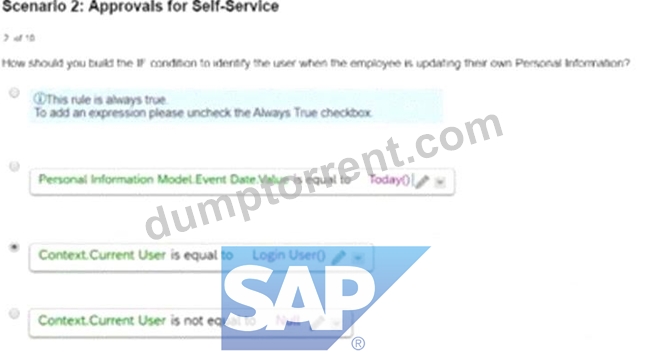
- A. Option C
- B. Option B
- C. Option D
- D. Option A
Answer: A
Explanation:
To identify the user when the employee is updating their own personal information, the IF condition in Option C is correct. This configuration:
* Checks if the Context.Current User is equal to the Login User.
* Ensures that the rule applies only when the employee is making changes to their own personal data.
This approach is aligned with SAP SuccessFactors logic for self-service scenarios, enabling accurate identification of the user in such workflows.
Scenario 2: Approvals for Self-Service
NEW QUESTION # 26
Your customer wants to create an association, with the requirement that one division can belong to many business units. What association do you need to build?
- A. A Composite association in the division object definition
- B. A Composite association in the business unit object definition
- C. A Valid When association in the business unit object definition
- D. A Valid When association in the division object definition
Answer: D
Explanation:
To create an association where one division can belong to many business units, you must build a Valid When association in the Division object definition.
Valid When associations define conditions under which an object (e.g., a Division) is valid for another object (e.g., a Business Unit).
This setup supports the business rule that a single division may be linked to multiple business units while ensuring data integrity in the hierarchical structure.
NEW QUESTION # 27
How do you enable a cost center in the Succession Data Model to be used as a filter in a permission group?
- A. Go to <hris-element="jobInfo"> then add dg-filter="true"
- B. Go to <custom-filters> then add cost-center
- C. Go to <dg-filters> then add cost-center
- D. Go to <hris-field id="cost-center"> then add filter="true"
Answer: C
Explanation:
To enable a cost center in the Succession Data Model for use as a filter in a permission group, you must:
Navigate to the <dg-filters> section within the Succession Data Model.
Add an entry for the cost-center object within the <dg-filters> section.
This action allows the cost center to be selectable as a filter for Dynamic Groups, which are used to define permission groups in Employee Central.
Correct answer:
A: Go to <dg-filters> then add cost-center
NEW QUESTION # 28
Which fields are required when importing Personal Information? Note: There are 2 correct answers to this question.
- A. User Id
- B. Username
- C. Personal Id External
- D. Event Date
Answer: C,D
Explanation:
When importing Personal Information into SAP SuccessFactors Employee Central, the following fields are mandatory:
B . Event Date
This field specifies the effective date of the personal information record. It is crucial for maintaining accurate historical data and ensuring that changes are applied from the correct date.
SAP Help Portal
D . Person Id External
The person-id-external serves as a unique identifier for the individual across all employment records within the system. It is essential for linking personal information to the correct person.
SAP Help Portal
Options A and C are not required for importing Personal Information:
A . Username
The username is associated with system login credentials and is not a required field for importing personal information.
C . User Id
The user-id pertains to employment records and is not mandatory for the Personal Information import process.
NEW QUESTION # 29
Which permission controls a user's access to the Edit button in the history of Job Information?
- A. Job Information Actions > Edit/Insert
- B. Job Information Actions > Correct
- C. Job Information Actions > View History
- D. Edit Link > Edit/Insert
Answer: B
Explanation:
Job Information Actions > Correct permission controls the Edit button in the Job Information history.
This permission allows users to correct existing records without creating a new effective-dated record. It ensures that only authorized users can make retroactive changes to historical data.
Other permissions, such as Edit Link > Edit/Insert, Job Information Actions > Edit/Insert, or Job Information Actions > View History, do not directly control access to the Edit button in the history section.
NEW QUESTION # 30
Fields in the termination screen are configured in which hris-element?
- A. Compensation Information
- B. Job Information
- C. Employment Information
- D. Personal Information
Answer: C
Explanation:
Fields displayed on the termination screen are configured in the Employment Information HRIS element. This element contains employment-specific details, such as hire dates, termination dates, and reasons for termination.
Other HRIS elements like Personal Information, Compensation Information, and Job Information do not manage termination-specific configurations
NEW QUESTION # 31
How do you create country-specific fields for the Legal Entity object?
- A. As a generic object with a Valid When association to the Legal Entity object
- B. As an HRIS element in the Corporate Data Model with a composite association to the Legal Entity object
- C. As an HRIS element in the Country Specific Field for Corporate Data Model with a Valid When association to the Legal Entity object
- D. As a generic object with a composite association to the Legal Entity object
Answer: C
Explanation:
To create country-specific fields for the Legal Entity object in SAP SuccessFactors Employee Central, you should define these fields as an HRIS element within the Country-Specific Field section of the Corporate Data Model. This approach allows the system to manage country-specific attributes effectively. The 'Valid When' association is utilized to ensure that these fields are applicable only when certain conditions, such as the country of registration, are met. This configuration ensures that the Legal Entity object contains fields relevant to specific countries, facilitating accurate data management and compliance with local regulations.
NEW QUESTION # 32
In your project, the client asks for a mechanism by which a workflow can be approved by any one of a pool of people. What tool would you use to configure the group?
- A. Manage Workflow Groups
- B. Manage Permission Groups
- C. Manage Dynamic Roles
- D. Manage Workflow Requests
Answer: A
Explanation:
To configure a workflow that can be approved by any one member of a designated group, you should use the Manage Workflow Groups tool. This functionality allows the creation of dynamic groups whose members can act as approvers in workflows. When such a group is assigned to a workflow, the approval request is sent to all group members, but only one member needs to take action to approve the workflow.
Options A, B, and C are not suitable for this requirement:
A . Manage Permission Groups
This tool is used to define groups for permission purposes and does not directly relate to workflow approvals.
B . Manage Dynamic Roles
Dynamic Roles are used to assign roles based on certain criteria but are not designed for grouping multiple users for workflow approvals.
C . Manage Workflow Requests
This tool is used to monitor and manage existing workflow requests, not to configure approval groups.
NEW QUESTION # 33
How should you build the IF condition to identity the user when the employee is updating their own Personal Information?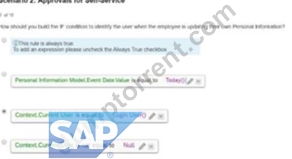
- A. Option C
- B. Option B
- C. Option D
- D. Option A
Answer: A
Explanation:
To identify the user when the employee is updating their own personal information, the IF condition in Option C is correct. This configuration:
Checks if the Context.Current User is equal to the Login User.
Ensures that the rule applies only when the employee is making changes to their own personal data.
This approach is aligned with SAP SuccessFactors logic for self-service scenarios, enabling accurate identification of the user in such workflows.
Scenario 2: Approvals for Self-Service
NEW QUESTION # 34
Which of the following are examples of standard one-to-one associations? Note: There are 2 correct answers to this question.
- A. Pay Range to Legal Entity
- B. Location to Geozone
- C. Department to Division
- D. Location to Legal Entity
Answer: A,B
Explanation:
Standard one-to-one associations link objects in a parent-child relationship, where each instance of the parent object is associated with one instance of the child object. Examples include:
Location to Geozone: A location belongs to one specific geozone.
Pay Range to Legal Entity: A pay range is tied to a single legal entity.
Location to Legal Entity and Department to Division are examples of one-to-many associations.
NEW QUESTION # 35
How do you set the event date in Compensation Information for the jobinfo_FTE_Comp cross-entity rule?
- A. Option C
- B. Option D
- C. Option B
- D. Option A
Answer: B
Explanation:
To set the event date in Compensation Information for the Jobinfo_FTE_Comp cross-entity rule, Option D is the correct method. The approach ensures that the Event Date field in the Compensation Information section aligns with the Event Date in Job Information. This synchronization is crucial for maintaining consistency in effective dates across entities during HR transactions.
Scenario 1: HR Transaction Rules
NEW QUESTION # 36
Which steps are required to set up the Auto Delegation feature for a workflow in Employee Central? Note:
There are 2 correct answers to this question.
- A. Enable the field in Succession Data Model.
- B. Define the delegate relationship in Employee Central.
- C. Enable the field in the Corporate Data Model.
- D. Enable the auto-delegate permission for users.
Answer: C,D
Explanation:
To set up the Auto Delegation feature in Employee Central workflows, the following steps are required:
* Enable Auto-Delegate Permission: Users must have the auto-delegate permission enabled, which allows them to define their delegates for workflows.
* Enable Auto-Delegation in the Corporate Data Model: This configuration ensures that the system recognizes and supports the auto-delegation functionality at the framework level.
Correct Answers:
* B: Enable the auto-delegate permission for users.
* D: Enable the field in the Corporate Data Model.
NEW QUESTION # 37
Your customer needs to set up a workflow to direct approval processes to the head of a business unit.
Which approver type do you use?
- A. Role
- B. Dynamic Group
- C. Dynamic Role
- D. Manager
Answer: C
Explanation:
To direct approval processes to the head of a business unit, you use a Dynamic Role. This approver type allows you to dynamically assign approval tasks based on relationships such as the head of a specific organizational structure.
A Manager approver type refers to direct line managers, which is different from business unit heads.
Dynamic Groups and Roles do not specifically address the dynamic nature of organizational roles like a business unit head.
NEW QUESTION # 38
You want the Timezone field to be pre-populated when the location record is changed in Job Info. How do you configure this?
- A. Base Object: Job Information; Assigned to Timezone field as onChange
- B. Base Object: Location; Assigned to Timezone field as onSave
- C. Base Object: Job Information; Assigned to Location field as onChange
- D. Base Object: Location: Assigned to Timezone field as onChange
Answer: C
Explanation:
To pre-populate the Timezone field when the location record is changed in Job Information, you need to configure the association as follows:
* Base Object: Job Information
* Trigger Event: Assigned to the Location field with the event set to onChange.This configuration ensures that whenever the Location field is updated in Job Information, the system triggers the logic to update and pre-populate the Timezone field based on the associated Location. The onChange event drives this functionality.
NEW QUESTION # 39
......
Free C-THR81-2505 Exam Dumps to Improve Exam Score: https://prepaway.dumptorrent.com/C-THR81-2505-braindumps-torrent.html