


Pass Juniper Design - Associate (JNCIA-Design) Exam in First Attempt Guaranteed Updated Dump from DumpTorrent!
Pass JN0-1103 Exam with 328 Questions - Verified By DumpTorrent
NEW QUESTION # 58
What is the first step of business continuity planning?
- A. formulate the plan
- B. know your network
- C. test the plan
- D. assess the risk
Answer: B
NEW QUESTION # 59
The business requirements RFP element contains which two items? (Choose two.)
- A. A detailed report that describes the facility specifications.
- B. An explanation of why a new design is required.
- C. A summary the type of business the customer is in.
- D. The number of users and workstation requirements.
Answer: B,C
NEW QUESTION # 60
On an SRX Series device, what are three match criteria of a security policy? (Choose three.)
- A. security zone
- B. QoS
- C. MAC address
- D. application port
- E. IP address
Answer: A,D,E
NEW QUESTION # 61
Which two versions of the Juniper SRX are appropriate for deployment in a virtual environment? (Choose two.)
- A. SRX1500
- B. vSRX
- C. SRX300
- D. cSRX
Answer: B,D
Explanation:
cSRX and vSRX are the virtualized versions of the Juniper SRX Series firewalls designed for deployment in virtual environments. The cSRX is containerized, while the vSRX is a VM-based firewall, both supporting advanced security services in cloud or virtualized data centers.
NEW QUESTION # 62
You are designing a network design in which access between different groups must be tightly restricted.
What should you do to accomplish this task?
- A. A Layer 2 switch
- B. A Layer 4 firewall
- C. A Layer 3 switch
- D. A Layer 7 IDP
Answer: B
NEW QUESTION # 63
You are planning a data center deployment of Juniper Networks switches interconnected into a Virtual Chassis Fabric at 40 Gbps.
Which three choices are available to interconnect the switches within the 23 feet (7 meters) distance limitation imposed by the data center? (Choose three.)
- A. direct attach copper
- B. active optical fiber
- C. cat6E
- D. SFP
- E. passive optical fiber
Answer: A,B,E
NEW QUESTION # 64
Your customers new network contains network devices from multiple vendors. You have been asked to propose two technologies that will work among all the vendors' networking equipment.
Which two technologies can you recommend for the design? (Choose two.)
- A. VTP
- B. VPLS
- C. HSRP
- D. VRRP
Answer: B,D
NEW QUESTION # 65
You are asked to design a backup schedule using existing tools and incurring no additional expense.
Which two protocols would you consider to accomplish this task? (Choose two.)
- A. SMTP
- B. SFTP
- C. rsync
- D. SNMP
Answer: B,C
Explanation:
rsync and SFTP are commonly used, cost-free tools for creating and scheduling secure backups of configuration files or data. Both support automation via scripts, making them suitable for designing a reliable backup solution without incurring additional costs.
NEW QUESTION # 66
You are working with a customer who specializes in selling custom toy boxes in more than 50 stores.
The customer's financial information must be kept secure.
Which security standard should you include in your design proposal?
- A. PCI compliance
- B. BYOD
- C. user-based firewall
- D. NAC
Answer: A
NEW QUESTION # 67
The business continuity RFP element contains which two requirements? (Choose two.)
- A. Network efficiency requirements
- B. QoS requirements
- C. Traffic requirements
- D. Wired connection requirements
Answer: A,B
NEW QUESTION # 68
A hospital has issued an RFP for a full network refresh. The RFP focuses on the users, applications, and bandwidth.
Which two realistic assumptions would be inferred about this network? (Choose two.)
- A. Quality of service (QoS) is not necessary.
- B. Regulatory requirements must be considered.
- C. Network downtime will not be tolerated.
- D. WiFi services must support video.
Answer: B,C
NEW QUESTION # 69
What is a feature provided by devices in the WAN aggregation site of a large enterprise WAN deployment?
- A. power redundancy
- B. DHCP
- C. Internet gateway
- D. MACsec
Answer: C
NEW QUESTION # 70
In which two instances should you use Postman as part of network automation? (Choose two.)
- A. to connect network infrastructure with cloud applications
- B. to write custom scripts in the Python programming language
- C. to receive real-time updates from a device without polling
- D. to perform prototyping of API requests
Answer: A,D
Explanation:
Postman is commonly used to prototype API requests, making it ideal for testing and verifying network APIs before automation scripts are developed. It also helps in connecting network infrastructure to cloud applications by crafting and sending REST API calls to interact with cloud-based services and platforms.
NEW QUESTION # 71
Click the Exhibit button.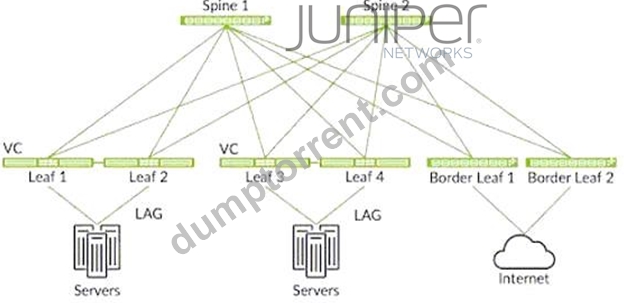
After a series of outages in an existing network, you are asked to analyze and provide recommendations for resiliency for the data center network shown in the exhibit.
Which improvement should you recommend to eliminate management plane single points of failure in this scenario?
- A. Configure ESI-LAG on the spines facing the leafs.
- B. Configure a Virtual Chassis between the spines.
- C. Replace the Virtual Chassis with VRRP configured on the servers.
- D. Replace the Virtual Chassis with ESI-LAG from the leafs facing the servers.
Answer: D
Explanation:
Using a Virtual Chassis (VC) introduces a single point of failure in the management plane, as all member switches depend on a master for control. Replacing the VC with ESI-LAG (Ethernet Segment Identifier - Link Aggregation Group) allows dual-homed servers to connect to independent leaf switches while maintaining resiliency and independent management planes-thus eliminating the single point of failure.
NEW QUESTION # 72
Which two reasons show the importance of understanding a user's applications when designing a network solution? (Choose two.)
- A. Quality of service (QoS) can be optimized for specific applications.
- B. Network virtualization might not support all real-time applications.
- C. The network engineer can infer traffic patterns.
- D. Network management can be optimized for specific applications.
Answer: A,C
NEW QUESTION # 73
You are asked to provide a WAN design proposal for connecting together multiple customer sites. As part of your design, you want to use IPsec tunnels to ensure that traffic is private and secure.
Which statement is true about the proposed solution?
- A. IPsec can require MTU modifications to accommodate the additional overhead.
- B. Packets that are passed through an IPsec tunnel are not encrypted.
- C. IPsec tunnels will require an MPLS infrastructure through the WAN.
- D. IPsec packets can be fragmented once encrypted.
Answer: A
NEW QUESTION # 74
Which solution would ensure that voice traffic is treated with a higher priority than data traffic throughout a network?
- A. link aggregation
- B. 802.1Q VLAN tags
- C. class of service
- D. routing instance
Answer: C
NEW QUESTION # 75
You are designing a highly resilient network, which two high availability techniques should you use?
(Choose two.)
- A. Stateless failover for firewall platforms.
- B. Chassis clusters for firewall platforms.
- C. Redundant firewall filters for firewall platforms.
- D. Stateful failover for firewall platforms.
Answer: B,D
NEW QUESTION # 76
Which statement is true about 3-stage IP fabrics?
- A. There must be physical connections between all of the spine nodes.
- B. There must be physical connections between all of the leaf nodes.
- C. Each leaf node must have at least two physical connections to each spine node.
- D. Each leaf node must have at least one physical connection to each spine node.
Answer: D
Explanation:
In a 3-stage IP fabric, each leaf node must connect to every spine node to ensure full mesh connectivity at Layer 3 between leafs via the spine layer. This design supports ECMP and optimal traffic distribution across the fabric.
NEW QUESTION # 77
Your company requires the ability to quickly recover from a misconfigured router breaking its forwarding and control planes. They decide to deploy terminal servers with connections to all router console ports to provide this capability.
Which two strategies will satisfy the requirements? (Choose two.)
- A. Connect the terminal servers using a parallel network of separate routers.
- B. Connect the terminal servers using a 4G LTE modem.
- C. Connect the terminal servers using a switch connected to inet6.0 on the production network routers.
- D. Connect the terminal servers using a switch connected to a separate routing instance on the production network routers.
Answer: A,B
Explanation:
For reliable out-of-band management and recovery from misconfigurations, terminal servers should be connected through a separate network, such as a 4G LTE modem or a parallel network of independent routers.
This ensures access remains available even if the production network is down.
NEW QUESTION # 78
Which compliance standard must be taken into account when designing a network that will be handling credit card transactions?
- A. HIPPA
- B. SOX
- C. PCI
- D. FIPS
Answer: C
NEW QUESTION # 79
......
Juniper JN0-1103 Exam Syllabus Topics:
| Topic | Details |
|---|---|
| Topic 1 |
|
| Topic 2 |
|
| Topic 3 |
|
| Topic 4 |
|
Penetration testers simulate JN0-1103 exam: https://prepaway.dumptorrent.com/JN0-1103-braindumps-torrent.html