


2022 Easily pass Professional-Cloud-Developer Exam with our Dumps & PDF Test Engine
Professional-Cloud-Developer PDF Pass Leader, Professional-Cloud-Developer Latest Real Test
NEW QUESTION 10
You are designing a deployment technique for your new applications on Google Cloud. As part of your deployment planning, you want to use live traffic to gather performance metrics for both new and existing applications. You need to test against the full production load prior to launch. What should you do?
- A. Use canary deployment
- B. Use A/B testing with traffic mirroring during deployment
- C. Use blue/green deployment
- D. Use rolling updates deployment
Answer: A
NEW QUESTION 11
You are parsing a log file that contains three columns: a timestamp, an account number (a string), and a transaction amount (a number). You want to calculate the sum of all transaction amounts for each unique account number efficiently.
Which data structure should you use?
- A. A two-dimensional array
- B. A linked list
- C. A comma-delimited string
- D. A hash table
Answer: D
NEW QUESTION 12
Leigh states that her MacBook Pro (Retina, 15-inch, Mid 2015) does not recognize the SD card she brought with her. You have her reproduce the issue and discover that she is properly inserting the card. However, it is not recognized by Photos or Image Capture. What question should you ask next to isolate the issue to hardware?
- A. Are you running the latest version of Photos?
- B. Have you had this issue with all SD cards or just this one?
- C. What kind of files or images are on the SD card?
- D. Have you tried resetting your SMC and NVRAM?
Answer: B
NEW QUESTION 13
You are using Cloud Build to build a Docker image. You need to modify the build to execute unit and run integration tests. When there is a failure, you want the build history to clearly display the stage at which the build failed.
What should you do?
- A. Add RUN commands in the Dockerfile to execute unit and integration tests.
- B. Create a Cloud Build build config file with separate cloud builder steps to compile and execute unit and integration tests.
- C. Create a Cloud Build build config file that will spawn a separate cloud build pipeline for unit and integration tests.
- D. Create a Cloud Build build config file with a single build step to compile unit and integration tests.
Answer: B
NEW QUESTION 14
You have decided to migrate your Compute Engine application to Google Kubernetes Engine. You need to build a container image and push it to Artifact Registry using Cloud Build. What should you do? (Choose two.) A) Run gcloud builds submit in the directory that contains the application source code.
B)
Run gcloud run deploy app-name --image gcr.io/$PROJECT_ID/app-name in the directory that contains the application source code.
C)
Run gcloud container images add-tag gcr.io/$PROJECT_ID/app-name gcr.io/$PROJECT_ID/app-name:latest in the directory that contains the application source code.
D)
In the application source directory, create a file named cloudbuild.yaml that contains the following contents:
E)
In the application source directory, create a file named cloudbuild.yaml that contains the following contents: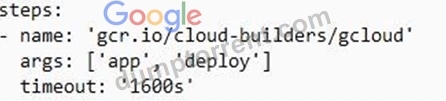
- A. Option B
- B. Option A
- C. Option E
- D. Option D
- E. Option C
Answer: B,D
Explanation:
https://cloud.google.com/sdk/gcloud/reference/builds/submit
https://cloud.google.com/artifact-registry/docs/configure-cloud-build
NEW QUESTION 15
Please refer to the following information to answer the questions on the right.
Lucille has issues with her Apple device and takes it to an Apple Service Provider where Baron, a technician, assists her. Without much knowledge about the technical aspects of her device, Lucille vaguely describes the issues to Baron.
Which two of the following behaviors will not help Baron understand Lucille's issue? (Choose two.)
- A. Reflect what Lucille says.
- B. Immediately suggest a solution to Lucille.
- C. Remain silent until Lucille is done.
- D. Try to prove that Lucille is wrong about the issue.
- E. Use appropriate body language to acknowledge Lucille's issue.
Answer: B,D
NEW QUESTION 16
Your development team has been asked to refactor an existing monolithic application into a set of composable microservices. Which design aspects should you implement for the new application? (Choose two.)
- A. Ensure that sufficient instances of the microservice are running to accommodate the performance requirements.
- B. Create an API contract agreement between the microservice implementation and microservice caller.
- C. Implement a versioning scheme to permit future changes that could be incompatible with the current interface.
- D. Develop the microservice code in the same programming language used by the microservice caller.
- E. Require asynchronous communications between all microservice implementations and microservice callers.
Answer: B,C
NEW QUESTION 17
You are working on a social media application. You plan to add a feature that allows users to upload images.
These images will be 2 MB - 1 GB in size. You want to minimize their infrastructure operations overhead for this feature.
What should you do?
- A. Set up a web server on GCP to accept user images and create a file store to keep uploaded files. Change the application to retrieve images from the file store.
- B. Create a separate bucket for each user in Cloud Storage. Assign a separate service account to allow write access on each bucket. Transfer service account credentials to the client application based on user information. The application uses this service account to upload images to Cloud Storage.
- C. Change the application to accept images directly and store them in the database that stores other user information.
- D. Change the application to create signed URLs for Cloud Storage. Transfer these signed URLs to the client application to upload images to Cloud Storage.
Answer: D
Explanation:
Explanation/Reference: https://cloud.google.com/blog/products/storage-data-transfer/uploading-images-directly-to-cloud- storage-by-using-signed-url
NEW QUESTION 18
You are creating an App Engine application that writes a file to any user's Google Drive.
How should the application authenticate to the Google Drive API?
- A. With an OAuth Client ID with delegated domain-wide authority.
- B. With the App Engine service account and https://www.googleapis.com/auth/drive.file scope that generates a signed JWT.
- C. With an OAuth Client ID that uses the https://www.googleapis.com/auth/drive.file scope to obtain an access token for each user.
- D. With the App Engine service account with delegated domain-wide authority.
Answer: A
NEW QUESTION 19
You have been tasked with planning the migration of your company's application from on-premises to Google Cloud. Your company's monolithic application is an ecommerce website. The application will be migrated to microservices deployed on Google Cloud in stages. The majority of your company's revenue is generated through online sales, so it is important to minimize risk during the migration. You need to prioritize features and select the first functionality to migrate. What should you do?
- A. Migrate Payment processing, which has integrations to the frontend, order database, and third-party payment vendor.
- B. Migrate Order fulfillment, which has integrations to the order database, inventory system, and third-party shipping vendor.
- C. Migrate the Product catalog, which has integrations to the frontend and product database.
- D. Migrate the Shopping cart, which has integrations to the frontend, cart database, inventory system, and payment processing system.
Answer: C
NEW QUESTION 20
Your company has a data warehouse that keeps your application information in BigQuery. The BigQuery data warehouse keeps 2 PBs of user data. Recently, your company expanded your user base to include EU users and needs to comply with these requirements:
Your company must be able to delete all user account information upon user request.
All EU user data must be stored in a single region specifically for EU users.
Which two actions should you take? (Choose two.)
- A. Create a dataset in the EU region that will keep information about EU users only.
- B. Use BigQuery federated queries to query data from Cloud Storage.
- C. Re-upload your data using to a Cloud Dataflow pipeline by filtering your user records out.
- D. Create a Cloud Storage bucket in the EU region to store information for EU users only.
- E. Use DML statements in BigQuery to update/delete user records based on their requests.
Answer: D,E
Explanation:
Reference:
https://cloud.google.com/solutions/bigquery-data-warehouse
NEW QUESTION 21
You are planning to migrate a MySQL database to the managed Cloud SQL database for Google Cloud. You have Compute Engine virtual machine instances that will connect with this Cloud SQL instance. You do not want to whitelist IPs for the Compute Engine instances to be able to access Cloud SQL.
What should you do?
- A. Create a CloudSQL instance on one project. Create Compute engine instances in a different project.
Create a VPN between these two projects to allow internal access to CloudSQL. - B. Enable private IP for the Cloud SQL instance.
- C. Whitelist a project to access Cloud SQL, and add Compute Engine instances in the whitelisted project.
- D. Create a role in Cloud SQL that allows access to the database from external instances, and assign the Compute Engine instances to that role.
Answer: D
Explanation:
Explanation/Reference: https://cloud.google.com/sql/docs/mysql/connect-external-app
NEW QUESTION 22
Your application takes an input from a user and publishes it to the user's contacts. This input is stored in a table in Cloud Spanner. Your application is more sensitive to latency and less sensitive to consistency.
How should you perform reads from Cloud Spanner for this application?
- A. Perform stale reads using read-write transactions.
- B. Perform Read-Only transactions.
- C. Perform strong reads using single-read methods.
- D. Perform stale reads using single-read methods.
Answer: A
Explanation:
Explanation/Reference: https://cloud.google.com/solutions/best-practices-cloud-spanner-gaming-database
NEW QUESTION 23
Case study
This is a case study. Case studies are not timed separately. You can use as much exam time as you would like to complete each case. However, there may be additional case studies and sections on this exam. You must manage your time to ensure that you are able to complete all questions included on this exam in the time provided.
To answer the questions included in a case study, you will need to reference information that is provided in the case study. Case studies might contain exhibits and other resources that provide more information about the scenario that is described in the case study. Each question is independent of the other questions in this case study.
At the end of this case study, a review screen will appear. This screen allows you to review your answers and to make changes before you move to the next section of the exam. After you begin a new section, you cannot return to this section.
To start the case study
To display the first question in this case study, click the Next button. Use the buttons in the left pane to explore the content of the case study before you answer the questions. Clicking these buttons displays information such as business requirements, existing environment, and problem statements. If the case study has an All Information tab, note that the information displayed is identical to the information displayed on the subsequent tabs. When you are ready to answer a question, click the Question button to return to the question.
Company Overview
HipLocal is a community application designed to facilitate communication between people in close proximity. It is used for event planning and organizing sporting events, and for businesses to connect with their local communities. HipLocal launched recently in a few neighborhoods in Dallas and is rapidly growing into a global phenomenon. Its unique style of hyper-local community communication and business outreach is in demand around the world.
Executive Statement
We are the number one local community app; it's time to take our local community services global. Our venture capital investors want to see rapid growth and the same great experience for new local and virtual communities that come online, whether their members are 10 or 10000 miles away from each other.
Solution Concept
HipLocal wants to expand their existing service, with updated functionality, in new regions to better serve their global customers. They want to hire and train a new team to support these regions in their time zones. They will need to ensure that the application scales smoothly and provides clear uptime data.
Existing Technical Environment
HipLocal's environment is a mix of on-premises hardware and infrastructure running in Google Cloud Platform.
The HipLocal team understands their application well, but has limited experience in global scale applications.
Their existing technical environment is as follows:
* Existing APIs run on Compute Engine virtual machine instances hosted in GCP.
* State is stored in a single instance MySQL database in GCP.
* Data is exported to an on-premises Teradata/Vertica data warehouse.
* Data analytics is performed in an on-premises Hadoop environment.
* The application has no logging.
* There are basic indicators of uptime; alerts are frequently fired when the APIs are unresponsive.
Business Requirements
HipLocal's investors want to expand their footprint and support the increase in demand they are seeing. Their requirements are:
* Expand availability of the application to new regions.
* Increase the number of concurrent users that can be supported.
* Ensure a consistent experience for users when they travel to different regions.
* Obtain user activity metrics to better understand how to monetize their product.
* Ensure compliance with regulations in the new regions (for example, GDPR).
* Reduce infrastructure management time and cost.
* Adopt the Google-recommended practices for cloud computing.
Technical Requirements
* The application and backend must provide usage metrics and monitoring.
* APIs require strong authentication and authorization.
* Logging must be increased, and data should be stored in a cloud analytics platform.
* Move to serverless architecture to facilitate elastic scaling.
* Provide authorized access to internal apps in a secure manner.
HipLocal's .net-based auth service fails under intermittent load.
What should they do?
- A. Use a dedicated Compute Engine virtual machine instance for the service.
- B. Use a Compute Engine cluster for the service.
- C. Use App Engine for autoscaling.
- D. Use Cloud Functions for autoscaling.
Answer: A
Explanation:
Explanation/Reference: https://www.qwiklabs.com/focuses/611?parent=catalog
NEW QUESTION 24
You have an application in production. It is deployed on Compute Engine virtual machine instances controlled by a managed instance group. Traffic is routed to the instances via a HTTP(s) load balancer. Your users are unable to access your application. You want to implement a monitoring technique to alert you when the application is unavailable.
Which technique should you choose?
- A. Managed instance group - heath checks
- B. Stackdriver uptime checks
- C. Smoke tests
- D. Cloud Load Balancing - heath checks
Answer: B
Explanation:
Reference:
476b8507f59c
NEW QUESTION 25
Case Study
Company Overview
HipLocal is a community application designed to facilitate communication between people in close proximity. It is used for event planning and organizing sporting events, and for businesses to connect with their local communities. HipLocal launched recently in a few neighborhoods in Dallas and is rapidly growing into a global phenomenon. Its unique style of hyper-local community communication and business outreach is in demand around the world.
Executive Statement
We are the number one local community app; it's time to take our local community services global. Our venture capital investors want to see rapid growth and the same great experience for new local and virtual communities that come online, whether their members are 10 or 10000 miles away from each other.
Solution Concept
HipLocal wants to expand their existing service, with updated functionality, in new regions to better serve their global customers. They want to hire and train a new team to support these regions in their time zones. They will need to ensure that the application scales smoothly and provides clear uptime data.
Existing Technical Environment
HipLocal's environment is a mix of on-premises hardware and infrastructure running in Google Cloud Platform.
The HipLocal team understands their application well, but has limited experience in global scale applications.
Their existing technical environment is as follows:
* Existing APIs run on Compute Engine virtual machine instances hosted in GCP.
* State is stored in a single instance MySQL database in GCP.
* Data is exported to an on-premises Teradata/Vertica data warehouse.
* Data analytics is performed in an on-premises Hadoop environment.
* The application has no logging.
* There are basic indicators of uptime; alerts are frequently fired when the APIs are unresponsive.
Business Requirements
HipLocal's investors want to expand their footprint and support the increase in demand they are seeing. Their requirements are:
* Expand availability of the application to new regions.
* Increase the number of concurrent users that can be supported.
* Ensure a consistent experience for users when they travel to different regions.
* Obtain user activity metrics to better understand how to monetize their product.
* Ensure compliance with regulations in the new regions (for example, GDPR).
* Reduce infrastructure management time and cost.
* Adopt the Google-recommended practices for cloud computing.
Technical Requirements
* The application and backend must provide usage metrics and monitoring.
* APIs require strong authentication and authorization.
* Logging must be increased, and data should be stored in a cloud analytics platform.
* Move to serverless architecture to facilitate elastic scaling.
* Provide authorized access to internal apps in a secure manner.
HipLocal wants to improve the resilience of their MySQL deployment, while also meeting their business and technical requirements.
Which configuration should they choose?
- A. Replace the current single instance MySQL instance with Cloud SQL, and Google provides redundancy without further configuration.
- B. Use the current single instance MySQL on Compute Engine, and replicate the data to Cloud SQL in an external master configuration.
- C. Replace the current single instance MySQL instance with Cloud SQL, and configure high availability.
- D. Use the current single instance MySQL on Compute Engine and several read-only MySQL servers on Compute Engine.
Answer: B
NEW QUESTION 26
Please refer to the following information to answer the questions on the right.
Debra has brought her iPad Pro to you for troubleshooting. She has been experiencing very slow charging of the battery and says the only way she can get a full charge is to leave the iPad alone for more than 12 hours.
She brought in an Apple Power adapter and Lightning to USB cable. When you examine the power adapter, you notice that it is an iPhone power adapter not an iPad power adapter. You also noticed she was using an iPhone 6s while waiting to see you. Debra thinks her iPad is defective because her iPhone has no issue charging with this power adapter and cable.
Based on the information Debra provided, which of the following resources can you share with her that explains the cause of the issue?
- A. Apple Service Guide
- B. Apple VMI Guide
- C. Apple Support articles
- D. GSX Troubleshooting articles
Answer: A
Explanation:
Explanation/Reference:
NEW QUESTION 27
Your teammate has asked you to review the code below, which is adding a credit to an account balance in Cloud Datastore. Which improvement should you suggest your teammate make?
- A. Get the entity with an ancestor query.
- B. Use a strongly consistent transactional database.
- C. Get and put the entity in a transaction.
- D. Don't return the account entity from the function.
Answer: A
NEW QUESTION 28
Your code is running on Cloud Functions in projectA . It is supposed to write an object in a Cloud Storage bucket owned by project B.
However, the write call is failing with the error "403 Forbidden".
What should you do to correct the problem?
- A. Grant your user account the roles/iam.serviceAccountUser role for the service-PROJECTA@gcf-adminrobot.
iam.gserviceaccount.com service account. - B. Grant the [email protected] service account the roles/ storage.objectCreator role for the Cloud Storage bucket.
- C. Grant your user account the roles/storage.objectCreator role for the Cloud Storage bucket.
- D. Enable the Cloud Storage API in project B.
Answer: A
NEW QUESTION 29
Which of the following are required to setup iTunes backup with an iPhone 8? (Choose two.)
- A. iTunes Store account
- B. iCloud account
- C. Computer compatible with iTunes
- D. Lightning to USB Cable
- E. Encrypted volume on Mac or PC
Answer: A,B
Explanation:
Explanation
Explanation/Reference: https://support.apple.com/guide/itunes/back-up-your-ios-or-ipados-device-itns3280/windows
NEW QUESTION 30
You are using Cloud Build to create a new Docker image on each source code commit to a Cloud Source Repositoties repository. Your application is built on every commit to the master branch. You want to release specific commits made to the master branch in an automated method. What should you do?
- A. Create a build trigger on a Git branch name pattern. Use a Git branch naming convention for new releases.
- B. Manually trigger the build for new releases.
- C. Commit your source code to a second Cloud Source Repositories repository with a second Cloud Build trigger. Use this repository for new releases only.
- D. Create a build trigger on a Git tag pattern. Use a Git tag convention for new releases.
Answer: A
Explanation:
Reference:
https://docs.docker.com/docker-hub/builds/
NEW QUESTION 31
Examine the image.
Which feature in macOS is opened by clicking on this dock icon?
- A. Launchpad
- B. Spotlight
- C. Finder
- D. System Preferences
Answer: A
Explanation:
Explanation/Reference: https://support.apple.com/en-us/HT202635
NEW QUESTION 32
You developed a JavaScript web application that needs to access Google Drive's API and obtain permission from users to store files in their Google Drives. You need to select an authorization approach for your application. What should you do?
- A. Create a service account.
- B. Create an API key.
- C. Create a SAML token.
- D. Create an OAuth Client ID.
Answer: D
NEW QUESTION 33
You have an application controlled by a managed instance group. When you deploy a new version of the application, costs should be minimized and the number of instances should not increase. You want to ensure that, when each new instance is created, the deployment only continues if the new instance is healthy. What should you do?
- A. Perform a rolling-action with maxSurge set to 0, maxUnavailable set to 1
- B. Perform a rolling-action with maxHealthy set to 1, maxUnhealthy set to 0.
- C. Perform a rolling-action with maxHealthy set to 0, maxUnhealthy set to 1.
- D. Perform a rolling-action with maxSurge set to 1, maxUnavailable set to 0.
Answer: D
NEW QUESTION 34
Case study
This is a case study. Case studies are not timed separately. You can use as much exam time as you would like to complete each case. However, there may be additional case studies and sections on this exam. You must manage your time to ensure that you are able to complete all questions included on this exam in the time provided.
To answer the questions included in a case study, you will need to reference information that is provided in the case study. Case studies might contain exhibits and other resources that provide more information about the scenario that is described in the case study. Each question is independent of the other questions in this case study.
At the end of this case study, a review screen will appear. This screen allows you to review your answers and to make changes before you move to the next section of the exam. After you begin a new section, you cannot return to this section.
To start the case study
To display the first question in this case study, click the Next button. Use the buttons in the left pane to explore the content of the case study before you answer the questions. Clicking these buttons displays information such as business requirements, existing environment, and problem statements. If the case study has an All Information tab, note that the information displayed is identical to the information displayed on the subsequent tabs. When you are ready to answer a question, click the Question button to return to the question.
Company Overview
HipLocal is a community application designed to facilitate communication between people in close proximity. It is used for event planning and organizing sporting events, and for businesses to connect with their local communities. HipLocal launched recently in a few neighborhoods in Dallas and is rapidly growing into a global phenomenon. Its unique style of hyper-local community communication and business outreach is in demand around the world.
Executive Statement
We are the number one local community app; it's time to take our local community services global. Our venture capital investors want to see rapid growth and the same great experience for new local and virtual communities that come online, whether their members are 10 or 10000 miles away from each other.
Solution Concept
HipLocal wants to expand their existing service, with updated functionality, in new regions to better serve their global customers. They want to hire and train a new team to support these regions in their time zones. They will need to ensure that the application scales smoothly and provides clear uptime data.
Existing Technical Environment
HipLocal's environment is a mix of on-premises hardware and infrastructure running in Google Cloud Platform.
The HipLocal team understands their application well, but has limited experience in global scale applications.
Their existing technical environment is as follows:
* Existing APIs run on Compute Engine virtual machine instances hosted in GCP.
* State is stored in a single instance MySQL database in GCP.
* Data is exported to an on-premises Teradata/Vertica data warehouse.
* Data analytics is performed in an on-premises Hadoop environment.
* The application has no logging.
* There are basic indicators of uptime; alerts are frequently fired when the APIs are unresponsive.
Business Requirements
HipLocal's investors want to expand their footprint and support the increase in demand they are seeing. Their requirements are:
* Expand availability of the application to new regions.
* Increase the number of concurrent users that can be supported.
* Ensure a consistent experience for users when they travel to different regions.
* Obtain user activity metrics to better understand how to monetize their product.
* Ensure compliance with regulations in the new regions (for example, GDPR).
* Reduce infrastructure management time and cost.
* Adopt the Google-recommended practices for cloud computing.
Technical Requirements
* The application and backend must provide usage metrics and monitoring.
* APIs require strong authentication and authorization.
* Logging must be increased, and data should be stored in a cloud analytics platform.
* Move to serverless architecture to facilitate elastic scaling.
* Provide authorized access to internal apps in a secure manner.
HipLocal's APIs are showing occasional failures, but they cannot find a pattern. They want to collect some metrics to help them troubleshoot.
What should they do?
- A. Install the Stackdriver Logging agent on the VMs.
- B. Use Stackdriver Trace to look for performance bottlenecks.
- C. Take frequent snapshots of all of the VMs.
- D. Install the Stackdriver Monitoring agent on the VMs.
Answer: D
Explanation:
Explanation/Reference:
NEW QUESTION 35
......
Professional-Cloud-Developer Dumps Ensure Your Passing: https://prepaway.dumptorrent.com/Professional-Cloud-Developer-braindumps-torrent.html