Free Demo


Pragmatic test practice software
To let the clients have an understanding of their mastery degree of our Associate-Developer-Apache-Spark-3.5 guide materials and get a well preparation for the test, we provide the test practice software to the clients. The test practice software of Associate-Developer-Apache-Spark-3.5 practice guide is based on the real test questions and its interface is easy to use. The test practice software boosts the test scheme which stimulate the real test and boost multiple practice models, the historical records of the practice of Associate-Developer-Apache-Spark-3.5 training materials and the self-evaluation function. The test software can help you practice the real Associate-Developer-Apache-Spark-3.5 questions. The clients can define the environment of the practice to adjust to their learning goals by themselves. Thus we can guarantee that you can get a high score in the test if you use our Associate-Developer-Apache-Spark-3.5 guide materials.
Pay high attention to the user experiences
Our service tenet is to let the clients get the best user experiences and be satisfied. From the research, compiling, production to the sales, after-sale service, we try our best to provide the conveniences to the clients and make full use of our Associate-Developer-Apache-Spark-3.5 guide materials. We organize the expert team to compile the Associate-Developer-Apache-Spark-3.5 practice guide elaborately and constantly update them. To let the clients have a fundamental understanding of our Associate-Developer-Apache-Spark-3.5 training materials, we provide the free trials before their purchasing. To save the clients' time, we send the products in the form of mails to the clients in 5-10 minutes after they purchase our Associate-Developer-Apache-Spark-3.5 practice guide and we simplify the information to let the client only need dozens of hours to learn and prepare for the test. To help the clients solve the problems which occur in the process of using our Associate-Developer-Apache-Spark-3.5 guide materials, the clients can consult u about the issues about our study materials at any time. To make the clients get a systematically and targeted learning, we provide multiple functions in our software. So we can say that our Associate-Developer-Apache-Spark-3.5 training materials are people-oriented and place the clients' experiences in the prominent position.
Free update within one year
We provide free update to the clients within one year. The clients can get more Associate-Developer-Apache-Spark-3.5 guide materials to learn and understand the latest industry trend. We boost the specialized expert team to take charge for the update of Associate-Developer-Apache-Spark-3.5 practice guide timely and periodically. They refer to the excellent published authors' thesis and the latest emerging knowledge points among the industry to update our Associate-Developer-Apache-Spark-3.5 training materials. After one year, the clients can enjoy 50 percent discounts and the old clients enjoy some certain discounts when purchasing. So the clients can enjoy more benefits after they buy our Associate-Developer-Apache-Spark-3.5 guide materials.
Nowadays the knowledge capabilities and mental labor are more valuable than the manual labor because knowledge can create more wealth than the mental labor. If you boost professional knowledge capabilities in some area you are bound to create a lot of values and can get a good job with high income. Passing the test of Databricks certification can help you achieve that, and our Associate-Developer-Apache-Spark-3.5 training materials are the best study materials for you to prepare for the test. Our Associate-Developer-Apache-Spark-3.5 guide materials combine the key information about the test in the past years' test papers and the latest emerging knowledge points among the industry to help the clients both solidify the foundation and advance with the times. We give priority to the user experiences and the clients' feedback, Associate-Developer-Apache-Spark-3.5 practice guide will constantly improve our service and update the version to bring more conveniences to the clients and make them be satisfied. The clients' satisfaction degrees about our Associate-Developer-Apache-Spark-3.5 training materials are our motive force source to keep forging ahead. Now you can have an understanding of our Associate-Developer-Apache-Spark-3.5 guide materials.

Databricks Associate-Developer-Apache-Spark-3.5 Exam Syllabus Topics:
| Section | Objectives |
|---|---|
| Topic 1: Spark SQL | - Window functions and aggregations - SQL queries on DataFrames and tables |
| Topic 2: Data Processing and Performance | - Joins and data partitioning - Caching and persistence strategies - Optimization techniques |
| Topic 3: Data Ingestion and Storage | - Reading and writing data (Parquet, JSON, CSV) - Delta Lake basics |
| Topic 4: Structured Streaming Basics | - Streaming DataFrames - Windowed aggregations in streaming |
| Topic 5: Apache Spark Fundamentals | - RDD vs DataFrame vs Dataset concepts - Spark architecture and execution model |
| Topic 6: DataFrame API with PySpark | - Transformations and actions - Built-in functions and expressions - DataFrame creation and schema management |
Databricks Certified Associate Developer for Apache Spark 3.5 - Python Sample Questions:
1. A data engineer is reviewing a Spark application that applies several transformations to a DataFrame but notices that the job does not start executing immediately.
Which two characteristics of Apache Spark's execution model explain this behavior?
Choose 2 answers:
A) Transformations are executed immediately to build the lineage graph.
B) The Spark engine optimizes the execution plan during the transformations, causing delays.
C) Transformations are evaluated lazily.
D) The Spark engine requires manual intervention to start executing transformations.
E) Only actions trigger the execution of the transformation pipeline.
2. What is the difference between df.cache() and df.persist() in Spark DataFrame?
A) Both functions perform the same operation. The persist() function provides improved performance as its default storage level is DISK_ONLY.
B) cache() - Persists the DataFrame with the default storage level (MEMORY_AND_DISK) and persist() - Can be used to set different storage levels to persist the contents of the DataFrame
C) persist() - Persists the DataFrame with the default storage level (MEMORY_AND_DISK_SER) and cache() - Can be used to set different storage levels to persist the contents of the DataFrame.
D) Both cache() and persist() can be used to set the default storage level (MEMORY_AND_DISK_SER)
3. Given the following code snippet in my_spark_app.py: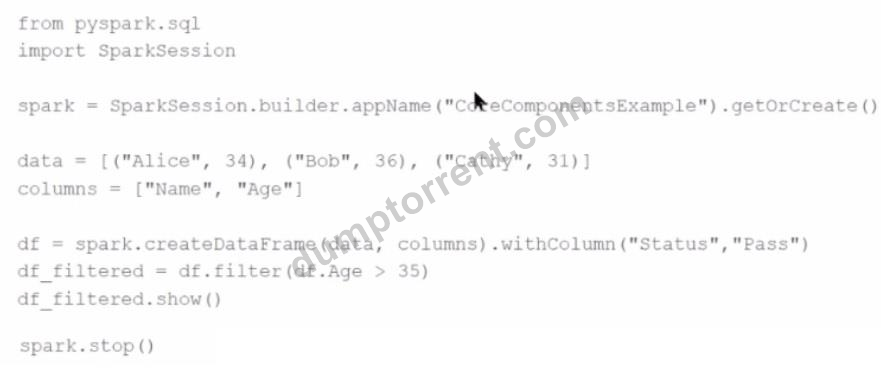
What is the role of the driver node?
A) The driver node orchestrates the execution by transforming actions into tasks and distributing them to worker nodes
B) The driver node only provides the user interface for monitoring the application
C) The driver node stores the final result after computations are completed by worker nodes
D) The driver node holds the DataFrame data and performs all computations locally
4. A data engineer is working on a real-time analytics pipeline using Apache Spark Structured Streaming. The engineer wants to process incoming data and ensure that triggers control when the query is executed. The system needs to process data in micro-batches with a fixed interval of 5 seconds.
Which code snippet the data engineer could use to fulfil this requirement?
A)
B)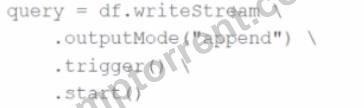
C)
D)
Options:
A) Uses trigger(processingTime=5000) - invalid, as processingTime expects a string.
B) Uses trigger(continuous='5 seconds') - continuous processing mode.
C) Uses trigger() - default micro-batch trigger without interval.
D) Uses trigger(processingTime='5 seconds') - correct micro-batch trigger with interval.
5. 13 of 55.
A developer needs to produce a Python dictionary using data stored in a small Parquet table, which looks like this:
region_id
region_name
10
North
12
East
14
West
The resulting Python dictionary must contain a mapping of region_id to region_name, containing the smallest 3 region_id values.
Which code fragment meets the requirements?
A) regions_dict = dict(regions.orderBy("region_id").limit(3).rdd.map(lambda x: (x.region_id, x.region_name)).collect())
B) regions_dict = dict(regions.select("region_id", "region_name").rdd.collect())
C) regions_dict = regions.select("region_id", "region_name").take(3)
D) regions_dict = dict(regions.take(3))
Solutions:
| Question # 1 Answer: C,E | Question # 2 Answer: B | Question # 3 Answer: A | Question # 4 Answer: D | Question # 5 Answer: A |


 Mandy
Mandy 
 Flora
Flora 
 Archibald
  Darren
 Abigail
  Tyler
Tyler  Maximilian
  Hunter
  Margaret
  Nick
Nick  Levi
Levi  Gabriel
  Chloe
Chloe  Phil
Phil  Mark
Mark  Carr
Carr